Part 107 weather, loading and performance practice questions
9 questions on Weather and Loading and Performance from the FAA Airman Certification Standards. Try each one, then open the answer to see the explanation and the FAA source it comes from.
At 7 p.m., a remote PIC gets an Outlook Briefing for a survey flight at 8 a.m. the next day. According to the AIM, what should the remote PIC do before launching?
A. Nothing more, since the Outlook Briefing already covered current conditions
B. Get a Standard or Abbreviated Briefing to update conditions and NOTAMs
C. Get a second Outlook Briefing about an hour before launch
Show the answer and explanation
Answer: B. Get a Standard or Abbreviated Briefing to update conditions and NOTAMs
The AIM recommends an Outlook Briefing when the proposed departure is six or more hours away and says it is for planning purposes only. Before departure, the pilot should get a Standard or Abbreviated Briefing for adverse conditions, current conditions, updated forecasts, winds aloft, and NOTAMs. AC 107-2A encourages remote PICs to get Flight Service weather information online at 1800wxbrief.com; the telephone service is intended for manned aircraft pilots only.
Why the other choices are wrong
A. Nothing more, since the Outlook Briefing already covered current conditions An Outlook Briefing is for planning purposes only. Even a Standard Briefing leaves out current conditions when departure is more than 2 hours away unless the pilot asks, so a briefing the night before cannot cover them.
C. Get a second Outlook Briefing about an hour before launch An Outlook Briefing is meant for a departure six or more hours away. Close to launch, the AIM calls for a Standard or Abbreviated Briefing.
This type of briefing is provided for planning purposes only. You should obtain a Standard or Abbreviated Briefing prior to departure in order to obtain such items as adverse conditions, current conditions, updated forecasts, winds aloft and NOTAMs, etc.
While Flight Service does offer a telephone-based service, it is intended for manned aircraft pilots only.
Question 2
A METAR from an automated station reports the sky condition as CLR. What does CLR mean?
A. No cloud layers are detected at or below 12,000 feet AGL
B. A human observer saw no cloud layers anywhere in the sky
C. Clouds cover less than one-eighth of the sky
Show the answer and explanation
Answer: A. No cloud layers are detected at or below 12,000 feet AGL
Automated stations code CLR when no cloud layers are detected at or below 12,000 feet, so higher clouds may still be present. A human observer uses SKC when no layers are seen at all, and any layer amount under one-eighth is reported as FEW.
Why the other choices are wrong
B. A human observer saw no cloud layers anywhere in the sky That describes SKC, which a human observer uses. CLR comes from automated stations and covers only layers up to 12,000 feet.
C. Clouds cover less than one-eighth of the sky A layer covering less than one-eighth of the sky is reported as FEW, not CLR.
When SKC is used, an observer indicates no layers are present; CLR is used by automated stations to indicate no layers are detected at or below 12,000 ft.
Clouds above 12,000 feet are not detected or reported by an automated station.
Question 3
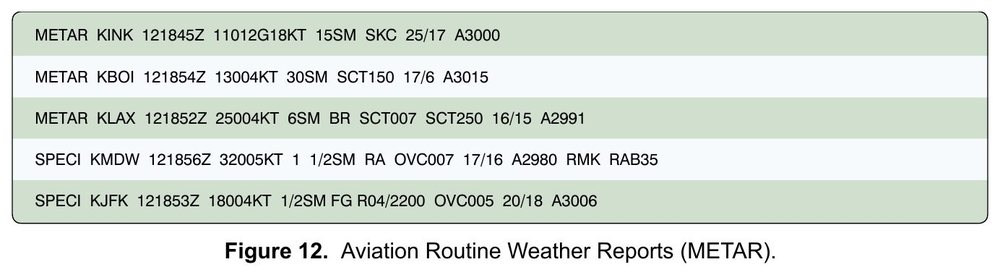
FAA-CT-8080-2H, Figure 12. Aviation Routine Weather Reports (METAR). FAA Airman Knowledge Testing Supplement (public domain). 2018 excerpt, not for navigation.
Refer to Figure 12. What peak gust speed does the KINK report show?
A. 6 knots
B. 12 knots
C. 18 knots
Show the answer and explanation
Answer: C. 18 knots
In 11012G18KT, 110 is the direction, 12 is the average speed in knots, and the number after G is the gust. The coded gust is the maximum instantaneous wind speed, here 18 knots.
Why the other choices are wrong
A. 6 knots That is the spread between the gust and the steady wind, not the gust itself.
B. 12 knots That is the average wind speed. The gust follows the letter G.
a wind out of the west at 20 kt with gusts to 35 kt would be coded 27020G35KT.
Question 4
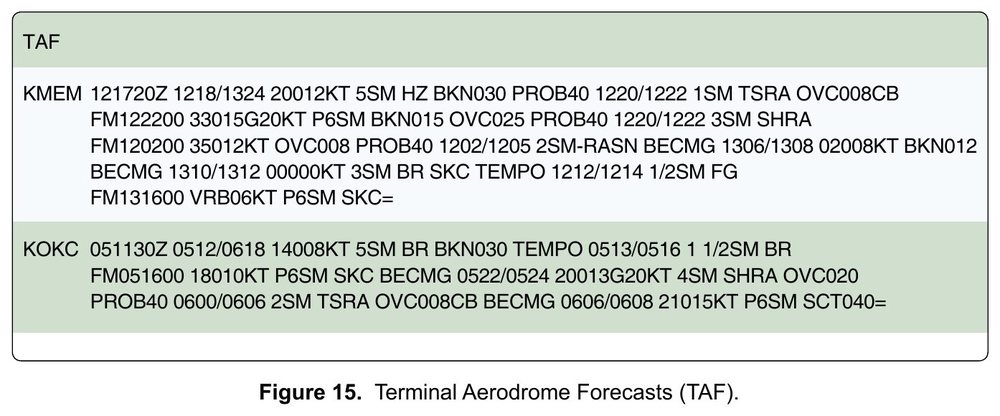
A TAF describes expected conditions within what distance of the center of an airport’s runway complex?
A. 5 statute miles
B. 10 statute miles
C. 25 statute miles
Show the answer and explanation
Answer: A. 5 statute miles
A TAF is a forecast for a specified time period within 5 statute miles of the center of the airport’s runway complex. Weather 5 to 10 statute miles away is described as in the vicinity (VC).
Why the other choices are wrong
B. 10 statute miles Ten statute miles is the outer edge of the vicinity (VC), which lies beyond the TAF’s 5-statute-mile area.
C. 25 statute miles A TAF covers only the terminal area within 5 statute miles of the runway complex.
A TAF is a concise statement of the expected meteorological conditions significant to aviation for a specified time period within 5 SM of the center of the airport’s runway complex (terminal).
The symbols on the front indicate the type of front and point in the direction toward which the front is moving.
Question 7
A remote PIC gets the wind from an airport's ASOS by telephone and also reads that station's METAR online. Which statement about the two wind directions is correct?
A. The phone report uses magnetic north, and the online METAR uses true north.
B. The phone report uses true north, and the online METAR uses magnetic north.
C. The phone report and the online METAR each use true north.
Show the answer and explanation
Answer: A. The phone report uses magnetic north, and the online METAR uses true north.
ASOS wind direction sent through national distribution (such as FSS, the internet, and FIS-B) is in true degrees, while local dissemination by radio and telephone is in magnetic degrees. METAR wind direction is coded relative to true north, so the online METAR and the phone report use different references.
Why the other choices are wrong
B. The phone report uses true north, and the online METAR uses magnetic north. This reverses the rule. Telephone and radio reports are in magnetic degrees, and the METAR distributed online is in true degrees.
C. The phone report and the online METAR each use true north. Only the online METAR uses true north. A telephone report is local dissemination, which gives wind direction in magnetic degrees.
Note: National network distribution (e.g., FSS, internet, and FIS-B) of wind direction is in true degrees, while local dissemination (e.g., radio and telephone) is in magnetic degrees.
It is coded in tens of degrees relative to true north using three figures.
Question 8
After a new camera is mounted, a small UA's center of gravity (CG) is outside the manufacturer's limits, though its total weight is under the maximum. What should the remote PIC do before flight?
A. Make no changes, since total weight is under the maximum
B. Move or remove weight until the CG is within allowable limits
C. Set the control trim to offset the shifted CG
Show the answer and explanation
Answer: B. Move or remove weight until the CG is within allowable limits
If the CG is not within the allowable limits after loading, the remote PIC must relocate or shed weight before attempting flight. Operating with the CG outside approved limits results in control difficulty, even when the total weight is acceptable.
Why the other choices are wrong
A. Make no changes, since total weight is under the maximum Staying under the maximum weight does not fix balance; operating with the CG outside approved limits results in control difficulty.
C. Set the control trim to offset the shifted CG Trim settings neither relocate nor shed weight, so the CG stays outside its limits; the study guide calls for relocating or shedding weight before flight.
If the CG is not within the allowable limits after loading or do not remain within the allowable limits for safe flight, it will be necessary to relocate or shed some weight before flight is attempted.
Operation with the center of gravity (CG) outside the approved limits results in control difficulty.
Question 9
A remote PIC buys a small UA whose manufacturer published no performance data. According to the study guide, what is a sensible starting point for performance planning?
A. Data from any similar-size small UA, whatever its maker
B. Generic figures the study guide gives for all small UA
C. Data that other users of the same model have published
Show the answer and explanation
Answer: C. Data that other users of the same model have published
Manufacturers may provide performance data such as takeoff, climb, range, endurance, descent, and landing figures, but that information is not standardized. If manufacturer data is unavailable, the study guide advises seeking data already published by other users of the same make and model and using it as a starting point.
Why the other choices are wrong
A. Data from any similar-size small UA, whatever its maker The study guide refers to users of the same manufacturer model, not any small UA of a similar size.
B. Generic figures the study guide gives for all small UA The study guide points to data published by other users of the same manufacturer model.
The manufacturer may provide operational and performance information that contains the operational performance data for the aircraft such as data pertaining to takeoff, climb, range, endurance, descent, and landing.
If manufacturer-published performance data is unavailable, it is advisable to seek out performance data that may have already been determined and published by other users of the same small UA manufacturer model and use that data as a starting point.
It should be emphasized that the manufacturers’ information regarding performance data is not standardized.
These questions are original and written from public FAA documents. Chartpass is not
affiliated with, endorsed by, or sponsored by the FAA. Chart excerpts are FAA public domain material and
are not for navigation.
 Chartpass