28 questions on Operations from the FAA Airman Certification Standards. Try each one, then open the answer to see the explanation and the FAA source it comes from.
Question 1
Near a towered airport, a remote PIC monitors the tower frequency to keep track of inbound airplanes. According to the AIM, about how far from the airport should manned pilots make their initial call to the tower?
A. About 5 miles
B. About 10 miles
C. About 15 miles
Show the answer and explanation
Answer: C. About 15 miles
At an airport with an operating control tower, pilots must keep two-way radio contact with the tower within the Class B, C, or D surface area unless the tower authorizes otherwise, and the AIM says the initial callup should be made about 15 miles from the airport. That is farther out than the 10-mile point used for CTAF calls at airports without an operating tower.
Why the other choices are wrong
A. About 5 miles That is closer than the AIM advises; it says the initial callup to the tower should be made about 15 miles from the airport.
B. About 10 miles Ten miles is where inbound pilots start monitoring and calling on the CTAF at an airport without an operating tower, not the tower callup distance.
pilots are required to maintain two-way radio contact with the tower while operating within the Class B, Class C, and Class D surface area unless the tower authorizes otherwise.
Pilots of inbound traffic should monitor and communicate as appropriate on the designated CTAF from 10 miles to landing.
Question 2
A remote PIC monitors the CTAF while flying near an airport without an operating control tower. Per the AIM, at what point should pilots of inbound manned aircraft start to monitor and communicate on the CTAF?
A. When entering the downwind leg
B. When 5 miles from the airport
C. When 10 miles from the airport
Show the answer and explanation
Answer: C. When 10 miles from the airport
The AIM recommends that pilots of inbound aircraft monitor and communicate on the CTAF from 10 miles out until landing. Some aircraft have no radio and some pilots may not announce, so a remote PIC monitoring the CTAF still needs to watch for traffic.
Why the other choices are wrong
A. When entering the downwind leg Inbound pilots should already be monitoring and communicating on the CTAF from 10 miles out, well before they reach the downwind leg.
B. When 5 miles from the airport The AIM recommends starting 10 miles out, not 5, so inbound pilots should already be on the CTAF by the time they are 5 miles away.
other aircraft may not have communication capability or, in some cases, pilots may not communicate their presence or intentions when operating into or out of such airports.
Question 3
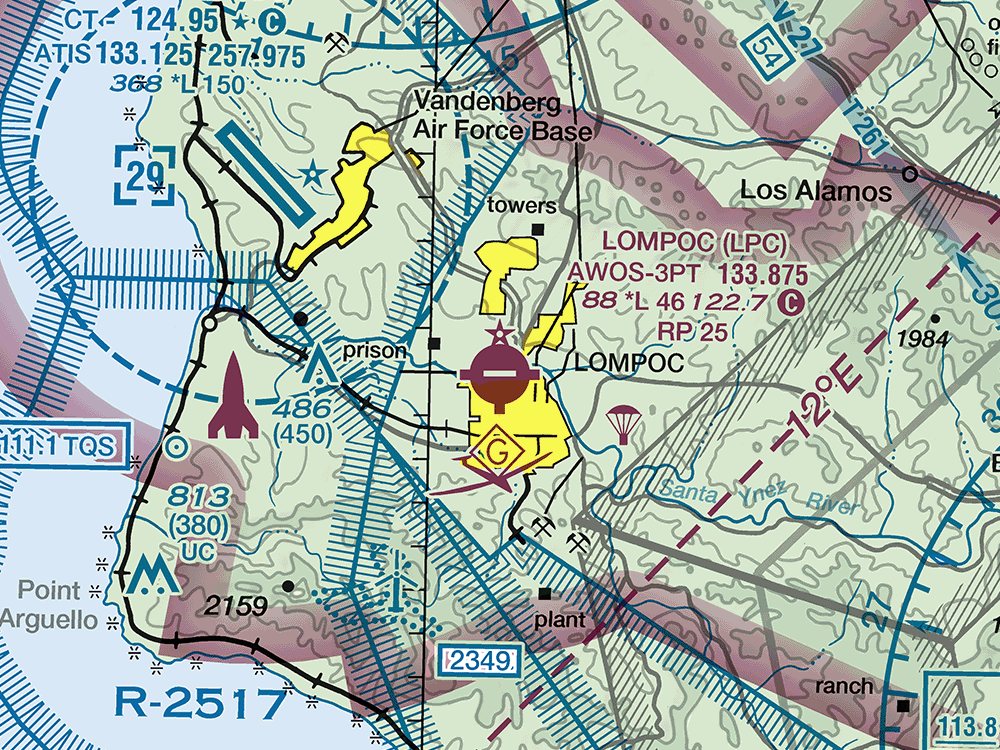
Sectional: Los Angeles, dated 29 OCT 2026 to 24 DEC 2026 FAA chart excerpt (public domain). Not for navigation.
Which frequency should a remote pilot monitor as the CTAF at LOMPOC (LPC)?
A. 122.7
B. 124.95
C. 133.875
Show the answer and explanation
Answer: A. 122.7
LOMPOC (LPC) is shown in magenta, so it has no control tower. In its data block, the frequency followed by a C in a solid circle is the CTAF: 122.7. Remote pilots can monitor it to hear manned traffic near the airport.
Why the other choices are wrong
B. 124.95 124.95 follows "CT -" in the blue data block cut off at the upper left. It is the control tower frequency of another airport (Vandenberg, VBG), not the CTAF of LOMPOC (LPC).
C. 133.875 133.875 follows "AWOS-3PT". It broadcasts automated weather, not traffic advisories.
A CTAF is a frequency designated for the purpose of carrying out airport advisory practices while operating to or from an airport without an operating control tower.
Question 4
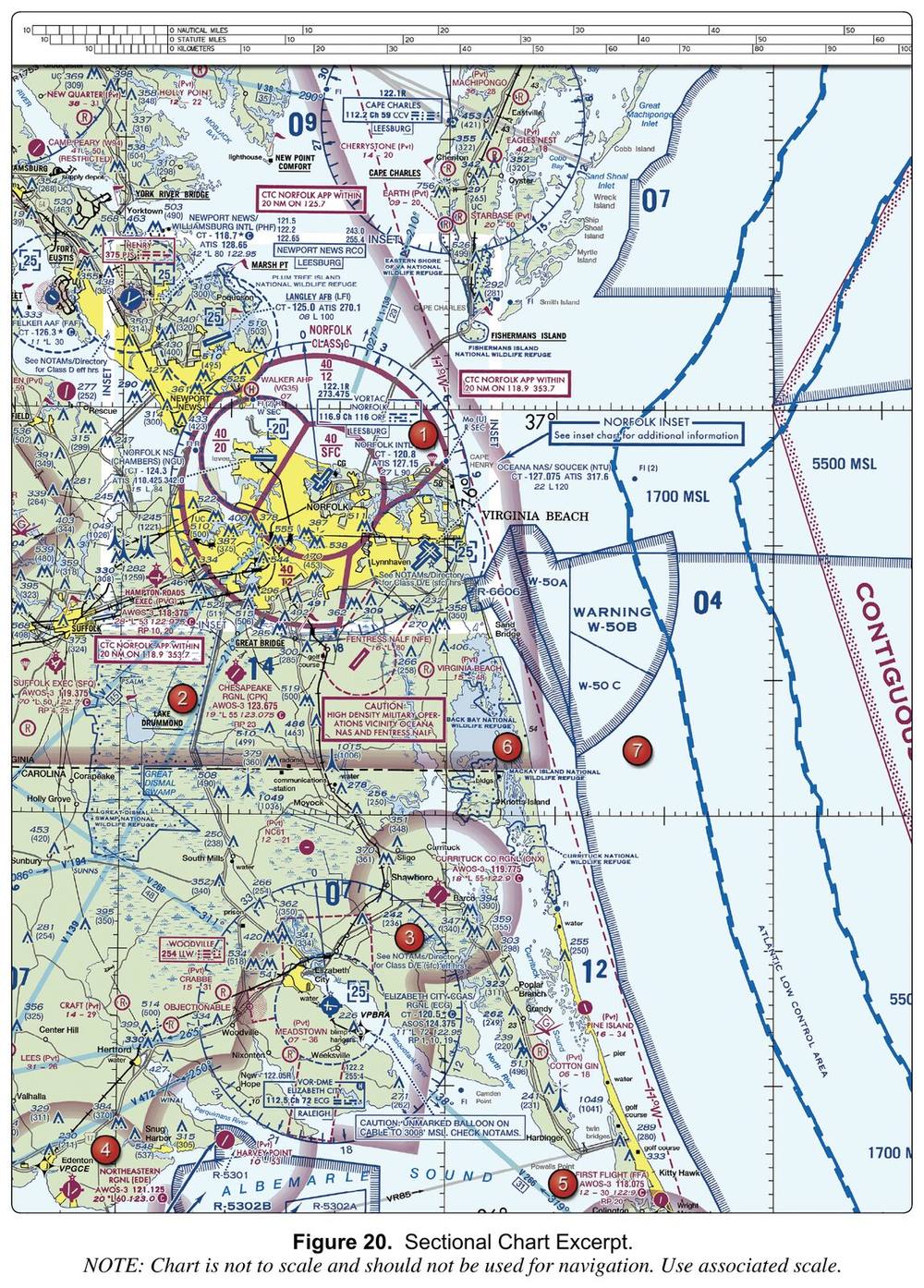
FAA-CT-8080-2H, Figure 20. Sectional Chart Excerpt. FAA Airman Knowledge Testing Supplement (public domain). 2018 excerpt, not for navigation.
Refer to Figure 20, area 2. A remote pilot flying near CHESAPEAKE RGNL (CPK) wants to listen for manned aircraft in the airport traffic pattern. Which frequency should the pilot monitor?
A. 118.9 MHz
B. 123.075 MHz
C. 123.675 MHz
Show the answer and explanation
Answer: B. 123.075 MHz
CHESAPEAKE RGNL is shown in magenta with no control tower. The frequency followed by the C symbol, 123.075, is its Common Traffic Advisory Frequency, which pilots use to exchange traffic information near an airport without an operating tower.
Why the other choices are wrong
A. 118.9 MHz That is a Norfolk Approach frequency for arriving aircraft, not the airport's traffic advisory frequency.
C. 123.675 MHz That is the AWOS-3 frequency, an automated weather broadcast.
A CTAF is a frequency designated for the purpose of carrying out airport advisory practices while operating to or from an airport without an operating control tower.
Question 5
Two nearby nontowered airports share the same CTAF. According to the AIM, how should pilots make clear which airport their self-announce calls refer to?
A. Say the airport name at the start and end of each call
B. Say “active runway” so listeners know which field is in use
C. Open each call with “Traffic in the area, please advise”
Show the answer and explanation
Answer: A. Say the airport name at the start and end of each call
Aircraft at a nearby airport may be self-announcing on the same UNICOM or MULTICOM frequency. To help listeners tell the airports apart, the AIM recommends speaking the airport name at the beginning and end of each self-announce transmission and using runway numbers instead of “active runway.”
Why the other choices are wrong
B. Say “active runway” so listeners know which field is in use The AIM says pilots should use the runway number and not the phrase “Active Runway.”
C. Open each call with “Traffic in the area, please advise” “Traffic in the area, please advise” is not a recognized self-announce phrase and should not be used.
It should be noted that aircraft operating to or from another nearby airport may be making self-announce broadcasts on the same UNICOM or MULTICOM frequency.
Pilots stating, “Traffic in the area, please advise” is not a recognized Self-Announce Position and/or Intention phrase and should not be used under any condition.
Question 6
Near a small public-use airport with no tower or FSS, a remote PIC monitoring the radio hears a ground operator give a pilot the wind and the recommended runway on request. What kind of station is this?
A. An ATIS, a continuous recorded broadcast for busy terminal areas
B. A UNICOM, a nongovernment air/ground radio station
C. An AWOS, which broadcasts computer-generated weather reports
Show the answer and explanation
Answer: B. A UNICOM, a nongovernment air/ground radio station
UNICOM is a nongovernment air/ground radio communication station that may provide airport information at public-use airports where there is no tower or FSS. On pilot request, a UNICOM may give weather information, wind direction, the recommended runway, or other needed information.
Why the other choices are wrong
A. An ATIS, a continuous recorded broadcast for busy terminal areas ATIS is a recorded, continuous broadcast in selected high-activity terminal areas, not an operator answering pilot requests.
C. An AWOS, which broadcasts computer-generated weather reports AWOS broadcasts automated, computer-generated observations; there is no operator to give a recommended runway.
UNICOM is a nongovernment air/ground radio communication station which may provide airport information at public use airports where there is no tower or FSS.
AWOS automatically provides computer-generated voice observations directly to aircraft in the vicinity of airports, using FAA ground-to-air radio.
Question 7
Before a flight near a towered airport, a remote PIC listens to its ATIS. The broadcast gives the wind, temperature, and altimeter setting but no ceiling or visibility, and no remark about them. What does this mean?
A. The ceiling is at least 5,000 feet, and visibility is at least 5 miles
B. The ceiling and visibility sensors are out of service for now
C. The ceiling is below 5,000 feet, or visibility is under 5 miles
Show the answer and explanation
Answer: A. The ceiling is at least 5,000 feet, and visibility is at least 5 miles
ATIS may leave out the ceiling or sky condition, visibility, and obstructions to vision when the ceiling is above 5,000 feet and the visibility is more than 5 miles. The AIM notes that the absence of a ceiling and visibility on ATIS indicates a ceiling of 5,000 feet or above and visibility of 5 miles or more.
Why the other choices are wrong
B. The ceiling and visibility sensors are out of service for now Leaving out the ceiling and visibility is how ATIS signals good weather, not an equipment outage.
C. The ceiling is below 5,000 feet, or visibility is under 5 miles It is the reverse: the AIM says the absence of a ceiling and visibility on ATIS indicates a ceiling of 5,000 feet or above and visibility of 5 miles or more.
The ceiling/sky condition, visibility, and obstructions to vision may be omitted from the ATIS broadcast if the ceiling is above 5,000 feet and the visibility is more than 5 miles.
The absence of a sky condition or ceiling and/or visibility on ATIS indicates a sky condition or ceiling of 5,000 feet or above and visibility of 5 miles or more.
Question 8
On the CTAF, a remote PIC hears a pilot call in as “Tango Baron Six One Eight Zulu.” According to the AIM, what does “Tango” at the start mean?
A. A student pilot who wants extra help from controllers
B. An air ambulance flight that is requesting priority handling
C. An air taxi or commercial operator without an FAA call sign
Show the answer and explanation
Answer: C. An air taxi or commercial operator without an FAA call sign
Air taxi or other commercial operators that don't have FAA-authorized call signs should prefix their normal identification with the phonetic word “Tango.” Student pilots instead say “student pilot,” and flights seeking medical priority say “MEDEVAC.”
Why the other choices are wrong
A. A student pilot who wants extra help from controllers Student pilots identify themselves by saying “student pilot” on initial contact, not by adding “Tango.”
B. An air ambulance flight that is requesting priority handling Air ambulance flights seeking priority handling say “MEDEVAC” before the call sign.
To receive priority handling from ATC, the pilot must verbally identify the flight in radio transmissions by stating “MEDEVAC” followed by the FAA authorized call sign
Question 9
A remote PIC monitoring the CTAF expects a call from a Cessna registered N26SZ, whose pilot will state the manufacturer's name and drop the N. Which call sign uses the AIM phonetic alphabet correctly?
A. Cessna Two Six Sugar Zebra
B. Cessna Two Six Sierra Zebra
C. Cessna Two Six Sierra Zulu
Show the answer and explanation
Answer: C. Cessna Two Six Sierra Zulu
The AIM says civil pilots state the aircraft type, model, or manufacturer followed by the registration's digits and letters, and drop the N prefix when they do, as in its example "Aztec Two Four Six Four Alpha." The AIM phonetic alphabet uses Sierra for S and Zulu for Z, so this Cessna's call sign is Cessna Two Six Sierra Zulu. Spelled out in full, the registration N26SZ would be November Two Six Sierra Zulu.
Why the other choices are wrong
A. Cessna Two Six Sugar Zebra Sugar and Zebra are not in the AIM phonetic alphabet. The table uses Sierra for S and Zulu for Z.
B. Cessna Two Six Sierra Zebra Sierra is correct for S, but Zebra is not an AIM phonetic word. The table uses Zulu for Z.
A remote PIC is hired to film a hospital whose rooftop helipad serves medical helicopters. Under the FAA’s definition of an airport, how is the helipad classified?
A. As an airport, since the term includes heliports
B. As a non-airport landing area, since it has no runway
C. As an airport only while a helicopter is on the pad
Show the answer and explanation
Answer: A. As an airport, since the term includes heliports
An airport is an area of land or water that is used or intended to be used for the landing and takeoff of aircraft. The FAA study guide adds that this includes special types of facilities such as seaplane bases and heliports, so a hospital’s rooftop heliport counts as an airport.
Why the other choices are wrong
B. As a non-airport landing area, since it has no runway The definition covers any area of land or water used or intended for landing or takeoff; no runway is needed.
C. As an airport only while a helicopter is on the pad The definition includes areas intended for landing or takeoff, so the helipad is an airport whether or not a helicopter is there.
Airport means an area of land or water that is used or intended to be used for the landing and takeoff of aircraft, and includes its buildings and facilities, if any.
special types of facilities including seaplane bases, heliports, and facilities to accommodate tilt rotor aircraft
Question 11
A remote PIC flying near an airport hears a helicopter pilot announce entering the traffic pattern. Compared with fixed-wing traffic, where may the helicopter fly its pattern?
A. Higher, at 1,500 feet AGL, and wider than the airplane pattern
B. Lower, at about 500 feet AGL, and closer to the runway
C. At 1,000 feet AGL, in the same pattern as propeller airplanes
Show the answer and explanation
Answer: B. Lower, at about 500 feet AGL, and closer to the runway
The AIM recommends that propeller-driven airplanes enter the traffic pattern at 1,000 feet AGL, and large or turbine-powered aircraft at not less than 1,500 feet AGL or 500 feet above the established pattern altitude. Helicopters may fly a similar pattern at a lower altitude, 500 feet AGL, and closer to the runway, so a remote PIC should expect helicopter traffic lower than airplane traffic.
Why the other choices are wrong
A. Higher, at 1,500 feet AGL, and wider than the airplane pattern 1,500 feet AGL applies to large and turbine-powered aircraft entering the pattern, not to helicopters.
C. At 1,000 feet AGL, in the same pattern as propeller airplanes 1,000 feet AGL is the recommended entry altitude for propeller-driven airplanes. Helicopters may fly lower and closer to the runway.
Helicopters operating in the traffic pattern may fly a pattern similar to the fixed-wing aircraft pattern, but at a lower altitude (500 AGL) and closer to the runway.
Large and turbine-powered aircraft enter the traffic pattern at an altitude of not less than 1,500 feet AGL or 500 feet above the established pattern altitude.
Question 12
Planning a survey near a nontowered airport, a remote PIC sees “RP 34” in the airport's data on the sectional chart. What does this tell the remote PIC?
A. Runway 34 uses a right-hand traffic pattern
B. Runway 34 is restricted to private use by the owner
C. Runway 34 has pilot-controlled runway lighting
Show the answer and explanation
Answer: A. Runway 34 uses a right-hand traffic pattern
VFR charts show right traffic with the abbreviation RP, for right pattern, followed by the runway number. “RP 34” means aircraft using Runway 34 fly a right-hand pattern. An asterisk (*RP) would send the pilot to the Chart Supplement for special instructions or restrictions.
Why the other choices are wrong
B. Runway 34 is restricted to private use by the owner On VFR charts, RP marks a right traffic pattern, not a private-use restriction.
C. Runway 34 has pilot-controlled runway lighting RP marks a right traffic pattern, not runway lighting.
Special conditions or restrictions to the right pattern are indicated by the use of an asterisk (*RP) to direct the pilot to the Chart Supplement for special instructions and/or restrictions.
Question 13
After a small UA strikes a bird during a survey, the remote PIC collects feathers so the species can be identified. According to AC 150/5200-32C, where should the remains go?
A. To the FAA, along with the online strike report
B. To the nearest Flight Standards District Office (FSDO)
C. To the Smithsonian’s Feather Identification Lab
Show the answer and explanation
Answer: C. To the Smithsonian’s Feather Identification Lab
The FAA encourages anyone with knowledge of a wildlife strike to report it, preferably electronically. For identification, AC 150/5200-32C says remains that cannot be identified by airport personnel or a local biologist can be sent, with FAA Form 5200-7, to the Feather Identification Lab at the Smithsonian Institution. It stresses: do not send bird remains to the FAA.
Why the other choices are wrong
A. To the FAA, along with the online strike report The AC says in capital letters not to send bird remains to the FAA; the strike report goes to the FAA, but the remains do not.
B. To the nearest Flight Standards District Office (FSDO) FSDOs are one place to get paper strike report forms, not where remains go for identification.
Paper copies of FAA Form 5200-7 may also be obtained from the appropriate Airports District Offices (ADO), Flight Standards District Offices (FSDO), and Flight Service Stations (FSS)
Birdstrike remains that cannot be identified by airport personnel or by a local biologist can be sent (with FAA Form 5200-7) to the Smithsonian Museum for identification.
Question 14
During a twilight flight near a lake, a remote PIC sees a beacon flashing white and yellow alternately. What does it mark?
A. A lighted heliport
B. A lighted military airport
C. A lighted water airport
Show the answer and explanation
Answer: C. A lighted water airport
Beacon colors identify the type of airport: white and green for a lighted land airport, white and yellow for a lighted water airport, and green, yellow, and white for a lighted heliport. Military airports alternate white and green, with two quick white flashes between the green flashes.
Why the other choices are wrong
A. A lighted heliport Heliport beacons flash green, yellow, and white.
B. A lighted military airport Military airport beacons alternate white and green, with two quick white flashes between the green flashes.
Military airport beacons flash alternately white and green, but are differentiated from civil beacons by dualpeaked (two quick) white flashes between the green flashes.
Question 15
A small UA loses its control link and starts its preprogrammed lost-link procedure, but the remote PIC cannot reestablish a positive link. According to the AIM’s Pilot/Controller Glossary, what must happen?
A. The UA continues its mission on autopilot
B. The UA has its flight deliberately terminated
C. The UA climbs and holds until the link returns
Show the answer and explanation
Answer: B. The UA has its flight deliberately terminated
A lost link procedure is the preprogrammed or predetermined mitigation that keeps a UA operating safely after a lost link. The P/CG says that if a positive link cannot be established, flight termination must be implemented: the intentional and deliberate process of ending the UA’s flight after an unrecoverable lost link, loss of control, or other failure that compromises safety.
Why the other choices are wrong
A. The UA continues its mission on autopilot Continuing the mission is not the defined outcome; when a positive link cannot be established, flight termination must be implemented.
C. The UA climbs and holds until the link returns Holding for the link to return is not the defined outcome when a positive link cannot be established.
The intentional and deliberate process of terminating the flight of a UA in the event of an unrecoverable lost link, loss of control, or other failure that compromises the safety of flight.
Question 16
A remote PIC's mapping flight depends on GPS. The U.S. government sometimes runs tests and exercises that interfere with GPS signals. According to the AIM, how are these events advertised?
A. In GPS or WAAS NOTAMs for the affected area
B. On the current sectional chart
C. In the Chart Supplement's airport remarks
Show the answer and explanation
Answer: A. In GPS or WAAS NOTAMs for the affected area
Government GPS tests, training, and exercises can interfere with GPS signals. The AIM says these events are geographically limited, scheduled, and advertised via GPS and/or WAAS NOTAMs, and operators of GPS aircraft should always check for them before flight.
Why the other choices are wrong
B. On the current sectional chart Sectional charts are not where the AIM says GPS test events are advertised.
C. In the Chart Supplement's airport remarks The AIM points to GPS and WAAS NOTAMs, not to the Chart Supplement, for these events.
These events are geographically limited, coordinated, scheduled, and advertised via GPS and/or WAAS NOTAMS.
Question 17
A remote PIC plans to fly a small UA around the far side of a large warehouse, with the building between it and the control station. The control link uses 5.8 GHz. What does AC 107-2A say about this?
A. The building can block the link, since 2.4 and 5.8 GHz are line-of-sight bands
B. The 5.8 GHz link will pass through the building better than a 2.4 GHz link
C. The link will keep working through the building as long as it stays within range
Show the answer and explanation
Answer: A. The building can block the link, since 2.4 and 5.8 GHz are line-of-sight bands
AC 107-2A says the 2.4 GHz and 5.8 GHz bands are both line of sight, and the command and control link will not work properly when barriers are between the control station and the aircraft. Keeping the aircraft in sight, as Part 107 requires, also helps keep obstructions out of the signal path. The plan has a second problem: Part 107 requires the remote PIC and the person manipulating the controls to be able to see the aircraft throughout the flight, and using a VO does not remove that requirement.
Why the other choices are wrong
B. The 5.8 GHz link will pass through the building better than a 2.4 GHz link AC 107-2A treats both 2.4 GHz and 5.8 GHz as line-of-sight bands; neither works properly through barriers.
C. The link will keep working through the building as long as it stays within range Range isn't the only limit: the AC says the link won't work properly when barriers are between the control station and the aircraft.
both RF bands (2.4 GHz and 5.8 GHz) are considered line of sight and the command and control link between the CS and the small unmanned aircraft will not work properly when barriers are between the CS and the unmanned aircraft.
Part 107 requires the remote PIC or person manipulating the controls to be able to see the unmanned aircraft at all times, which should also help prevent obstructions from interfering with the line of sight frequency spectrum.
the remote pilot in command, the visual observer (if one is used), and the person manipulating the flight control of the small unmanned aircraft system must be able to see the unmanned aircraft throughout the entire flight
Although the remote PIC and person manipulating the controls must maintain the capability to see the small unmanned aircraft
Question 18
A remote PIC is planning a night inspection at a site with several unlit towers and buildings. Which hazard of night operations does AC 107-2A's risk assessment guidance name for this kind of site?
A. Night vision adaptation with unlit obstacles in the area
B. Radio interference from the circuits powering tower lights
C. Ice forming on the towers as the air cools after dark
Show the answer and explanation
Answer: A. Night vision adaptation with unlit obstacles in the area
AC 107-2A's risk assessment steps tell the remote PIC to identify the hazards of flying at night, including flights that span day, twilight, and night. One hazard it names is night vision adaptation when unlit towers and buildings are present in the area of operation.
Why the other choices are wrong
B. Radio interference from the circuits powering tower lights The AC's night hazard list does not mention interference from lighting circuits.
C. Ice forming on the towers as the air cools after dark The AC lists weather and terrain as night hazards, but not icing on structures at the site.
Such potential hazards include night vision adaptation when unlit towers and buildings are present in the area of operation.
Question 19
A remote PIC flies alone, with no visual observer or other crew. According to the FAA study guide, which concept applies CRM principles to this kind of operation?
A. Maintenance resource management (MRM)
B. Automatic (naturalistic) decision-making
C. Single-Pilot Resource Management (SRM)
Show the answer and explanation
Answer: C. Single-Pilot Resource Management (SRM)
CRM focuses on crews, but many of its principles also apply to one-person operations. The study guide says this led to Single-Pilot Resource Management (SRM): managing all the resources available to a single pilot before and during flight.
Why the other choices are wrong
A. Maintenance resource management (MRM) MRM is named as a related human factors term, not as the single-pilot form of CRM.
B. Automatic (naturalistic) decision-making Automatic decision-making is a fast, experience-based way of deciding, not the single-pilot form of CRM.
Many CRM principles have been successfully applied to single-pilot aircraft and led to the development of Single-Pilot Resource Management (SRM).
Question 20
During a long day of flights in summer heat, a remote PIC stops drinking water. According to the FAA study guide, what is usually the first noticeable effect of dehydration?
A. A feeling of fatigue
B. Extreme thirst
C. Tingling in the hands
Show the answer and explanation
Answer: A. A feeling of fatigue
The first noticeable effect of dehydration is fatigue, which makes top physical and mental performance difficult. If fluid isn't replaced, it progresses to dizziness, weakness, nausea, tingling of the hands and feet, abdominal cramps, and extreme thirst. Thirst itself arrives too late to be a reliable warning.
Why the other choices are wrong
B. Extreme thirst Extreme thirst comes later, as fatigue progresses. The thirst mechanism also arrives too late to give early warning.
C. Tingling in the hands Tingling of the hands and feet is a later stage that follows fatigue if fluid isn't replaced.
The problem is that the thirst mechanism arrives too late
Question 21
A remote PIC starts taking a new prescription medication. According to FAA guidance, how long should the remote PIC wait after the first dose before flying, to check for adverse side effects?
A. At least 8 hours
B. At least 24 hours
C. At least 48 hours
Show the answer and explanation
Answer: C. At least 48 hours
For any new medication, prescription or over-the-counter, FAA guidance is to wait at least 48 hours after the first dose before flying. The wait shows whether the drug causes side effects that would make it unsafe to operate an aircraft.
Why the other choices are wrong
A. At least 8 hours Eight hours is the minimum time after drinking alcohol, not the waiting period for a new medication.
B. At least 24 hours Twenty-four hours is too short. The guidance for any new medication is at least 48 hours after the first dose.
For any new medication, OTC or prescribed, you should wait at least 48 hours after the first dose before flying to determine you do not have any adverse side effects that would make it unsafe to operate an aircraft.
Consumed any alcoholic beverage within the preceding 8 hours;
Question 22
A visual observer begins to hyperventilate after a near miss, then consciously slows the rate and depth of breathing. According to the AIM, how soon should the symptoms usually subside?
A. Within a few minutes
B. In about an hour
C. After hours of rest
Show the answer and explanation
Answer: A. Within a few minutes
Hyperventilation blows off too much carbon dioxide. The AIM says the symptoms subside within a few minutes after the rate and depth of breathing are consciously brought back under control.
Why the other choices are wrong
B. In about an hour The AIM describes a much faster recovery, within a few minutes.
C. After hours of rest No long rest period is needed; the AIM says symptoms subside within a few minutes.
The symptoms of hyperventilation subside within a few minutes after the rate and depth of breathing are consciously brought back under control.
Question 23
A remote PIC works all day beside a loud, vibrating generator at a job site. According to the FAA study guide, which kind of stressor are the noise and vibration?
A. Physical stress
B. Physiological stress
C. Psychological stress
Show the answer and explanation
Answer: A. Physical stress
A stressor is anything that causes a person to experience stress. The study guide sorts stressors into physical stress (noise or vibration), physiological stress (fatigue), and psychological stress (difficult work or personal situations).
Why the other choices are wrong
B. Physiological stress The study guide's example of physiological stress is fatigue, not noise or vibration.
C. Psychological stress Psychological stress comes from difficult work or personal situations, not noise or vibration.
Examples of stressors include physical stress (noise or vibration), physiological stress (fatigue), and psychological stress (difficult work or personal situations).
Question 24
While flying over fresh snow on a sunny day, a remote PIC is squinting and the eyes are watering from glare. What kind of sunglasses does the AIM recommend?
A. Lenses that let at least 85 percent of visible light through
B. Neutral lenses that absorb at least 85 percent of visible light
C. Tinted lenses that filter some colors much more strongly than others
Show the answer and explanation
Answer: B. Neutral lenses that absorb at least 85 percent of visible light
Glare from snow, water, clouds, or desert terrain can cause squinting, watering eyes, and even temporary blindness. The AIM recommends sunglasses that absorb at least 85 percent of visible light (15 percent transmittance) and absorb all colors equally (neutral transmittance).
Why the other choices are wrong
A. Lenses that let at least 85 percent of visible light through That reverses the AIM's figure: lenses should absorb at least 85 percent, letting through about 15 percent.
C. Tinted lenses that filter some colors much more strongly than others The AIM calls for neutral lenses that absorb all colors equally.
Excessive illumination, especially from light reflected off the canopy, surfaces inside the aircraft, clouds, water, snow, and desert terrain, can produce glare, with uncomfortable squinting, watering of the eyes, and even temporary blindness.
Sunglasses for protection from glare should absorb at least 85 percent of visible light (15 percent transmittance) and all colors equally (neutral transmittance)
Question 25
A remote PIC spends a long day working in bright sunlight before a night flight. According to the AIM, how can that daytime exposure affect night vision?
A. It speeds up dark adaptation once the sun sets
B. It affects color vision only, not dark adaptation
C. It impairs dark adaptation once the sun sets
Show the answer and explanation
Answer: C. It impairs dark adaptation once the sun sets
In darkness, the eyes grow more sensitive to light through dark adaptation, which takes at least 30 minutes of total darkness to complete. The AIM says dark adaptation is impaired by prolonged exposure to bright sunlight, carbon monoxide from smoking or exhaust, a lack of vitamin A, and cabin altitudes above 5,000 feet.
Why the other choices are wrong
A. It speeds up dark adaptation once the sun sets The AIM lists prolonged exposure to bright sunlight as something that impairs dark adaptation, not something that speeds it up.
B. It affects color vision only, not dark adaptation The AIM says prolonged bright sunlight impairs dark adaptation itself.
In darkness, vision becomes more sensitive to light, a process called dark adaptation. Although exposure to total darkness for at least 30 minutes is required for complete dark adaptation
Dark adaptation is impaired by exposure to cabin pressure altitudes above 5,000 feet, carbon monoxide inhaled in smoking and from exhaust fumes, deficiency of Vitamin A in the diet, and by prolonged exposure to bright sunlight.
Question 26
AC 107-2A’s recommended preflight inspection items include one check made with the small UA in the air. What is it?
A. Fly low near any interference and recheck the controls
B. Climb to 400 feet AGL and test the return-to-home function
C. Fly the full planned route once at the maximum speed
Show the answer and explanation
Answer: A. Fly low near any interference and recheck the controls
AC 107-2A recommends that the remote PIC’s preflight inspection include a series of visual or functional checks. Near the end of the list, the remote PIC starts the propellers to inspect for any imbalance or irregular operation and then, at a controlled low altitude, flies within range of any interference and rechecks all controls and stability.
Why the other choices are wrong
B. Climb to 400 feet AGL and test the return-to-home function The AC’s in-flight check is made at a controlled low altitude, not at 400 feet AGL.
C. Fly the full planned route once at the maximum speed The AC’s check is a controlled low-altitude test of controls and stability near interference, not a full-speed run of the route.
At a controlled low altitude, fly within range of any interference and recheck all controls and stability; and
Question 27
During preflight, a remote PIC notices that a lithium battery's casing is bulging. According to AC 107-2A, what may this indicate?
A. Impending failure, with possible abrupt power loss or explosion
B. A normal swelling from fast charging that goes away as the battery cools
C. Shorter flight time only, with no added fire risk
Show the answer and explanation
Answer: A. Impending failure, with possible abrupt power loss or explosion
AC 107-2A lists a distorted (bulging) battery casing among conditions that may mean the small UA is not in a condition for safe operation. A distorted casing may indicate impending failure resulting in abrupt power loss or explosion, and an electrical hazard with a risk of fire may be present, so the battery needs further inspection before any flight.
Why the other choices are wrong
B. A normal swelling from fast charging that goes away as the battery cools The AC treats a distorted casing as a sign of possible impending failure that calls for further inspection, not a normal condition.
C. Shorter flight time only, with no added fire risk The AC warns that a distorted casing may come with an electrical hazard and a risk of fire, not just less flight time.
below is a chart offering conditions that, if noticed during a preflight inspection or check, may support a determination that the small unmanned aircraft is not in a condition for safe operation.
An electrical hazard may be present, posing a risk of fire or extreme heat
Question 28
A survey company flies its small UAS many hours and cycles each week. According to AC 107-2A, what can methodical maintenance and inspection records help it track?
A. Each crew member's aeronautical knowledge recency
B. The airspace authorizations used for each of its jobs
C. Component service life and recurring failure events
Show the answer and explanation
Answer: C. Component service life and recurring failure events
AC 107-2A says recordkeeping can be an essential safety support for operators that rapidly build up flight hours or cycles. Methodical maintenance and inspection data helps track the service life of components and systemic component, equipage, and structural failure events.
Why the other choices are wrong
A. Each crew member's aeronautical knowledge recency Knowledge recency is a pilot certification matter, not part of the maintenance records the AC describes.
B. The airspace authorizations used for each of its jobs The AC's maintenance and inspection records track component life and failures, not airspace authorizations.
Methodical maintenance and inspection data collection can prove to be very helpful in the tracking of small UAS component service life, as well as systemic component, equipage, and structural failure events.
These questions are original and written from public FAA documents. Chartpass is not
affiliated with, endorsed by, or sponsored by the FAA. Chart excerpts are FAA public domain material and
are not for navigation.
 Chartpass